Friday, June 24, 2011

Sundiata’s Triumph by an anonymous writer

A record of one side of the Sumanguru’s defeat from The African Past: Chronicles from Antiquity to Modern Times by Basil Davidson.

In about the year 1240, according to tradition, the Mandingo ruler Sundiata Keita fought a crucial battle against the Sosso (Fulah) King Sumanguru, and won. This is generally accounted as the beginning of the empire of Mali. An anonymous manuscript in Arabic, recovered and translated by the late Maurice Delafosse, tells the story of this battle as popular memory recorded it long afterwards.


As Sundiata advanced with his army to meet Sumanguru, he learned that Sumanguru was also coming against him with an army prepared for battle. They met in a place called Kirina [not far from modern Koulikoro]. When Sundiata turned his eyes on the army of Sumanguru he believed they were a cloud and said: ‘What is this cloud on the eastern side?’ They told him it was the army of Sumanguru. As for Sumanguru, when he saw the army of Sundiata, he exclaimed: ‘What is that mountain of stone?’ For he thought it was a mountain. And they told him: ‘It is the army of Sundiata, which lies to the west of us.’ Then the two columns came together and fought a murderous battle; in the thick of the fight, Sundiata uttered a great shout in the face of the warriors of Sumanguru, and at once these ran to get behind Sumanguru; the latter in his return uttered a great shout in the face of the warriors of Sundiata, all of whom fled to get behind Sundiata. Usually, when Sumanguru shouted, eight heads would rise above his own head.

When they had done this, Sundiata said to Sangaran Danguinia Konnté: ‘Have you forgotten the taboo?’ [A reference to an earlier prophecy of Sumanguru’s imminent downfall, and the manner of its bringing about] As soon as Sangaran Danguinia heard Sundiata’s question he came to the front of the army, halted, grasped the arrow (spear?) armed with the spur of a white cock, and threw it at Sumanguru. As soon as it had struck Sumanguru, Sangaran said: ‘This is the arrow of him who knows the ancient secrets…’ While he was saying this, Sumanguru vanished and was seen no more. Now he had had a gold bracelet on his wrist, and this fell on that spot [i.e., at Kirina]; a baobab tree grew out of it and carries the mark to this day. [Fifty years ago, it is said, the people of Kirina would still show their visitors a baobab tree which they held to be the same one as grew there on the day of Sundiata’s famous victory]

…As for Sundiata, he defeated the army of Sumanguru, ravaged the land of the Susu and subjugated its people. Afterwards Sundiata became the ruler of an immense empire [Mali]…

Saturday, April 9, 2011

The Creator Nyame and His Four Wives

This is a story of the Krachi people of Ghana.


Nyame was married to Akoko, the barn-door fowl, but after a while he took to himself four other wives. Akoko, of course, retained her rights as the head wife, and the other four wives obeyed her.

One day Nyame called the four newcomers together and asked each one what present she would give him in return for his having raised her above other women in the tribe.

The first one promised that she would always sweep his compound for him and keep the place neat and tidy; the second said she would always cook for him and never complain when there were many visitors; the third agreed to spin cotton for him and to bring him all the water he might require; and the fourth one said that she would bear him a child of gold.

This last promise pleased Nyame, and everyday he killed a sheep for this woman. But the child was long in coming. Just when Nyame’s patience was giving out, the woman conceived, and Nyame detailed Akoko to tend and care for her.

So Akoko took the woman into her hut and, when the time of delivery was at hand, Akoko told her that, whatever else she did, she was to be sure to shut her eyes when the child was born and not to open them until she was told so. The woman obeyed, and Akoko hurried out and brought back a big pot.

Now it happened that the woman bore twins. The first one to be born was made entirely of silver, and Akoko at once took the babe and placed it in the pot. The second child was of gold, and Akoko placed it in the pot. Then she hurried outside and found two frogs. Returning with these, she placed them on the couch and then told the mother to open her eyes and see her children.

Then Akoko hastened out of the hut with the pot and ran with it as fast as she could to the far, far bush, where she found a dead odum tree. There she hid the pot with the two babies and then returned swiftly to Nyame’s compound, passing by his hut on the way. She told her husband that the children had been born and asked him to go with her to see his offspring.

Nyame at once arose and went to the hut where the mother was lying. To his consternation and anger, he found two frogs instead of the expected child of gold. He gave orders that the frogs were to be killed at once and that the woman should be sent into the farthermost corner of his kingdom.

Now it chanced that Nyame had a certain hunter whose hut was situated in the far bush. He happened to be out hunting on the day the children were born and his chase led him to the odum tree. There his eye was attracted by the glitter of the golden child and he cried out, “Why, what is this?”

The children answered him, “We are the children of Nyame.” But he could not believe that.

He took some of the dust that had fallen from their bodies, however, and put it into his bag. Then he took up the children and carried them to his hovel. There he kept them secretly, nor did he tell any man of what he had found.

And every time the hunter wanted money he would father some of the children’s dust. Thus he became a very rich man. Instead of having a solitary hovel in the bush, he built a huge compound and round him there gathered a great town.

Now not very far away there lived Ananse. One day he went out into the bush to gather some white ants for his fowls and he came across the new town. He was astounded to see that in the place where expected a hovel there was so much wealth and so many people. His curiosity aroused, Ananse entered the town to learn how the changed had come about. By sheer accident he espied the former hunter playing with the children. At once Ananse knew that the latter were the lost children of Nyame, and he hurried back home to send a message to their father. But the hunter had also seen Ananse, and he knew full well that busybody would betray his secret. Therefore he called the children and told them that, as they claimed they were the children of Nyame, and he proposed to take them to Nyame.

The next morning he prepared hammocks and fine clothes for the children and proceeded on the way to Nyame. On the road the children called their foster-father and told him that he must collect some stones with which to play wari, as they themselves could not speak to their father, but that the stones would tell him the whole story.

The man did som and they arrived before Nyame. There the hunter placed stools and asked Nyame if he would play a game of wari with him. Nyame agreed, but the silver child said, no, he himself wished to play, that the stones would tell the story for which they had come.

Then the silver child and Nyame sat down to the game and, as the stones went round and round the board, the golden child sang the story of their adventures from the time of their mother’s promise until their birth; he sang of the baseness of Akoko and of the kindness of the hunter who had fed them instead of killing them for their silver and gold.

The Nyame knew them to be his children, and he sent straightway into the far, far bush to call the woman whom he had exiled. When she arrived, she was dirty all over and her hair was uncut and unkempt. Nyame himself washed the woman, and when she was all clean and nice again he sent for Akoko.

Great was Nyame’s wrath. He tied the evil fowl Akoko, his first wife, by her foot to a stick and cursed her. Then he threw her down from the sky and gave orders that every time the fowl wished to drink she would first have to raise her head to him and beg. Further, Nyame gave orders that every man would in the future sacrifice fowls as the ordinary sacrifices to the gods.

Are not these things done to this day?

As for the children – once every year they are washed, and the dust from them falls upon the earth. Some falls on men, and these are the lucky ones who become wealthy.


Adrinka symbol, Tamfo Bebre, "the enemy will stew in his own juice", stands for jealousy and envy.

Wednesday, April 6, 2011

Peter Tongolo

The story of a remarkable carpenter from the present US Virgin Islands (story in the photo).

Sunday, April 3, 2011

The West Indian Heritage

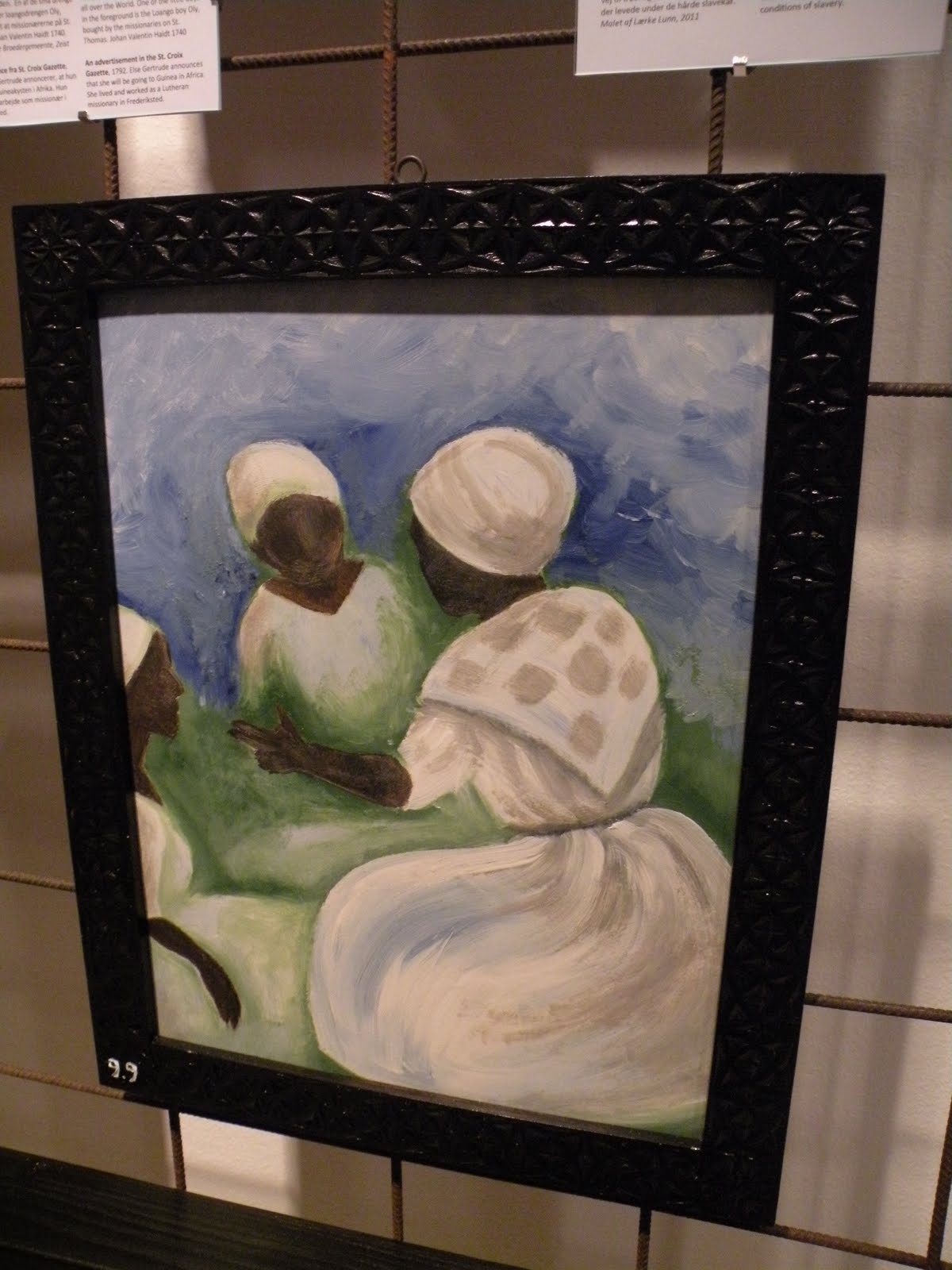
A new exhibition opened at the National Museum in Copenhagen yesterday. An exhibition of the West Indian Heritage (more specifically about the former Danish West Indies), which brings the buildings into the picture of the structure of the colony and its function. On top of that it will draw parallels to the situation and the heritage from today. Danes still tend to call the Virgin Islands ‘the Danish West Indies’, which is wrong and I wish they would quit it. Neither the islands nor the people have been under Danish rule for almost a hundred years. If I use the term, it will be in reference to the period where V.I. was a Danish colony. No, Danish slavery was not better than other countries’ doings. I took some pictures of the opening I want to share. It is an important subject, and I sincerely hope Denmark will pay back what they owe the populace of the V.I. by 2017, when it will be a hundred years since Denmark sold V.I. to USA.


Saturday, March 26, 2011

Black Woman

One of the poets I really like and admire is Léopold Sédar Senghor. His words look as if they dance across the paper, and it appears that I never stop to be amazed of his language of arts and truth. Needless to say, he was not only a poet but one of the greatest African intellectuals of the 20th century as he in 1960 became the first President of Republic Senegal and in the 1930s he was one of les trois pères, the three fathers, of the movement la Négritude along with Aimé Césaire (Martinique) and León Damas (French Guiana). In the 1920s and 30s movements and literary styles such as the Harlem Rennaissance swept over the African Diaspora and black students and scholars took up the yearning for Black solidarity against colonial racism which resulted in the controversial Négritude movement. Wole Soyinka, the Nigerian poet and novelist, opposed la Nègritude saying “Un tigre ne proclame pas sa tigritude, il saute sur sa proie” (“A tiger does not proclaim its tigerness; it jumps on its prey”). Nevertheless, la Nègritude is a marking point in Black history and a number of passionate writers have contributed to the movement, including Paul Niger and Guy Tirolien (Guadeloupe), Gilbert Gratiant and Edouard Glissant (Martinique), Jacques Roumain, Jean Brière, Félix Morisseau-Leroy and René Depestre (Haiti), Birago Diop and David Diop (Senegal), and Bernard Dadié (Côte d’Ivoire)

It annoys me so much that I have yet to learn French so I can read the great literature of the French Antilles and other French speaking areas because there is so so much Black history and literature in French. I am certain that his poems are even more beautiful in the original language. Until then I will post his poems in English for the masses, including myself.


“Naked woman, black woman

Clothed with your colour which is life,
with your form which is beauty!

In your shadow I have grown up; the
gentleness of your hands was laid over my eyes.

And now, high up on the sun-baked
pass, at the heart of summer, at the heart of
noon,
I come upon you, my Promised Land,
And your beauty strikes me to the heart
like the flash of an eagle.

Naked woman, dark woman

Firm-fleshed ripe fruit, sombre raptures
of black wine, mouth making lyrical my mouth
Savannah stretching to clear horizons,
savannah shuddering beneath the East Wind's
eager caresses

Carved tom-tom, taut tom-tom, muttering
under the Conqueror's fingers

Your solemn contralto voice is the
spiritual song of the Beloved.

Naked woman, dark woman

Oil that no breath ruffles, calm oil on the
athlete's flanks, on the flanks of the Princes of Mali
Gazelle limbed in Paradise, pearls are stars on the
night of your skin

Delights of the mind, the glinting of red
gold against your watered skin

Under the shadow of your hair, my care
is lightened by the neighbouring suns of your eyes.

Naked woman, black woman,
I sing your beauty that passes, the form
that I fix in the Eternal,

Before jealous fate turn you to ashes to
feed the roots of life.”

Saturday, August 21, 2010

Let no one uproot the Pumpkin

Okot p’Bitek’s Song of Lawino is a poem concerning the rural Acholi woman Lawino’s tribulations as her husband, Ocol, has turned ‘western’ and looks down upon his roots. Lawino, the defender of her people’s virtues and values, laments her husband’s modern ways of living, but his degrading reply is to be found in the book from 1970, Song of Ocol, where he mocks her defence.

The excerpt below is taken from Song of Lawino:

The Democratic Party
How does it differ
From the Congress?

Ocol says
They want Uhuru,
His brother says
They want Uhuru and Peace,
Both of them say they fight ignorance and disease!

Then why do they not join hands,
Why do they split up the army
Into two hostile groups?
The spears of the young men
And their shields,
Why are the weapons
And the men and women
Dispersed so uselessly?

And while the pythons of sickness
Swallow the children
And the buffalos of poverty
Knock the people down
And ignorance stands there
Like an elephant,

The war leaders
Are tightly locked in bloody feuds,
Eating each other’s liver
As if the D.P. was leprosy
And the Congress yaws;

If only the parties
Would fight poverty
With the fury
With which they fight each other,
If diseases and ignorance
Were assaulted
With the deadly vengeance
With which Ocol assaults his mother’s son,
The enemies would have been
Greatly reduced by now.

Okot p'Bitek was born in 1932 in Gulu, Northern Uganda to Acholi parents. He began writing in his mother tongue Lwo, one of the Western Nilotic languages, subsequently his works White Teeth and Song of Lawino were translated into English.
p'Bitek passed away on July 20, 1982.

Monday, June 28, 2010

Tomorrow

Tomorrow by Frank Kobina Parkes from Songs from the Wilderness, 1965.

"If you forever fix your eyes on muddy river banks
To see the slime and rotten eggs that foul the air
You lose sight of the graceful brook
Which though not clear, is not so dark
As to absorb your image

If you will ever strain your eyes on bloated, croaking frogs
Beside the stream, and filthy ducks that swim the tide
You may not taste the flowing spring
Which though not white, is yet not black
And can reflect your shadow

If you forever look with jaundiced eye on struggling man
And see his faults and only those - his darker self
You will deride the God-like soul
Which sleeps beneath. Yearns. Waits just a while
A brief, brief while to flower."

Related Posts Plugin for WordPress, Blogger...