Showing posts with label Africa. Show all posts
Showing posts with label Africa. Show all posts
Sunday, February 5, 2012
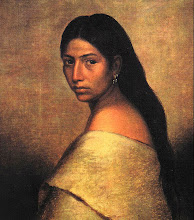
Memorable pictures: Fellah Woman

Saturday, April 9, 2011
The Creator Nyame and His Four Wives
This is a story of the Krachi people of Ghana.
Nyame was married to Akoko, the barn-door fowl, but after a while he took to himself four other wives. Akoko, of course, retained her rights as the head wife, and the other four wives obeyed her.
One day Nyame called the four newcomers together and asked each one what present she would give him in return for his having raised her above other women in the tribe.
The first one promised that she would always sweep his compound for him and keep the place neat and tidy; the second said she would always cook for him and never complain when there were many visitors; the third agreed to spin cotton for him and to bring him all the water he might require; and the fourth one said that she would bear him a child of gold.
This last promise pleased Nyame, and everyday he killed a sheep for this woman. But the child was long in coming. Just when Nyame’s patience was giving out, the woman conceived, and Nyame detailed Akoko to tend and care for her.
So Akoko took the woman into her hut and, when the time of delivery was at hand, Akoko told her that, whatever else she did, she was to be sure to shut her eyes when the child was born and not to open them until she was told so. The woman obeyed, and Akoko hurried out and brought back a big pot.
Now it happened that the woman bore twins. The first one to be born was made entirely of silver, and Akoko at once took the babe and placed it in the pot. The second child was of gold, and Akoko placed it in the pot. Then she hurried outside and found two frogs. Returning with these, she placed them on the couch and then told the mother to open her eyes and see her children.
Then Akoko hastened out of the hut with the pot and ran with it as fast as she could to the far, far bush, where she found a dead odum tree. There she hid the pot with the two babies and then returned swiftly to Nyame’s compound, passing by his hut on the way. She told her husband that the children had been born and asked him to go with her to see his offspring.
Nyame at once arose and went to the hut where the mother was lying. To his consternation and anger, he found two frogs instead of the expected child of gold. He gave orders that the frogs were to be killed at once and that the woman should be sent into the farthermost corner of his kingdom.
Now it chanced that Nyame had a certain hunter whose hut was situated in the far bush. He happened to be out hunting on the day the children were born and his chase led him to the odum tree. There his eye was attracted by the glitter of the golden child and he cried out, “Why, what is this?”
The children answered him, “We are the children of Nyame.” But he could not believe that.
He took some of the dust that had fallen from their bodies, however, and put it into his bag. Then he took up the children and carried them to his hovel. There he kept them secretly, nor did he tell any man of what he had found.
And every time the hunter wanted money he would father some of the children’s dust. Thus he became a very rich man. Instead of having a solitary hovel in the bush, he built a huge compound and round him there gathered a great town.
Now not very far away there lived Ananse. One day he went out into the bush to gather some white ants for his fowls and he came across the new town. He was astounded to see that in the place where expected a hovel there was so much wealth and so many people. His curiosity aroused, Ananse entered the town to learn how the changed had come about. By sheer accident he espied the former hunter playing with the children. At once Ananse knew that the latter were the lost children of Nyame, and he hurried back home to send a message to their father. But the hunter had also seen Ananse, and he knew full well that busybody would betray his secret. Therefore he called the children and told them that, as they claimed they were the children of Nyame, and he proposed to take them to Nyame.
The next morning he prepared hammocks and fine clothes for the children and proceeded on the way to Nyame. On the road the children called their foster-father and told him that he must collect some stones with which to play wari, as they themselves could not speak to their father, but that the stones would tell him the whole story.
The man did som and they arrived before Nyame. There the hunter placed stools and asked Nyame if he would play a game of wari with him. Nyame agreed, but the silver child said, no, he himself wished to play, that the stones would tell the story for which they had come.
Then the silver child and Nyame sat down to the game and, as the stones went round and round the board, the golden child sang the story of their adventures from the time of their mother’s promise until their birth; he sang of the baseness of Akoko and of the kindness of the hunter who had fed them instead of killing them for their silver and gold.
The Nyame knew them to be his children, and he sent straightway into the far, far bush to call the woman whom he had exiled. When she arrived, she was dirty all over and her hair was uncut and unkempt. Nyame himself washed the woman, and when she was all clean and nice again he sent for Akoko.
Great was Nyame’s wrath. He tied the evil fowl Akoko, his first wife, by her foot to a stick and cursed her. Then he threw her down from the sky and gave orders that every time the fowl wished to drink she would first have to raise her head to him and beg. Further, Nyame gave orders that every man would in the future sacrifice fowls as the ordinary sacrifices to the gods.
Are not these things done to this day?
As for the children – once every year they are washed, and the dust from them falls upon the earth. Some falls on men, and these are the lucky ones who become wealthy.

Adrinka symbol, Tamfo Bebre, "the enemy will stew in his own juice", stands for jealousy and envy.
Saturday, March 26, 2011
Black Woman
One of the poets I really like and admire is Léopold Sédar Senghor. His words look as if they dance across the paper, and it appears that I never stop to be amazed of his language of arts and truth. Needless to say, he was not only a poet but one of the greatest African intellectuals of the 20th century as he in 1960 became the first President of Republic Senegal and in the 1930s he was one of les trois pères, the three fathers, of the movement la Négritude along with Aimé Césaire (Martinique) and León Damas (French Guiana). In the 1920s and 30s movements and literary styles such as the Harlem Rennaissance swept over the African Diaspora and black students and scholars took up the yearning for Black solidarity against colonial racism which resulted in the controversial Négritude movement. Wole Soyinka, the Nigerian poet and novelist, opposed la Nègritude saying “Un tigre ne proclame pas sa tigritude, il saute sur sa proie” (“A tiger does not proclaim its tigerness; it jumps on its prey”). Nevertheless, la Nègritude is a marking point in Black history and a number of passionate writers have contributed to the movement, including Paul Niger and Guy Tirolien (Guadeloupe), Gilbert Gratiant and Edouard Glissant (Martinique), Jacques Roumain, Jean Brière, Félix Morisseau-Leroy and René Depestre (Haiti), Birago Diop and David Diop (Senegal), and Bernard Dadié (Côte d’Ivoire)
It annoys me so much that I have yet to learn French so I can read the great literature of the French Antilles and other French speaking areas because there is so so much Black history and literature in French. I am certain that his poems are even more beautiful in the original language. Until then I will post his poems in English for the masses, including myself.
“Naked woman, black woman
Clothed with your colour which is life,
with your form which is beauty!
In your shadow I have grown up; the
gentleness of your hands was laid over my eyes.
And now, high up on the sun-baked
pass, at the heart of summer, at the heart of noon,
I come upon you, my Promised Land,
And your beauty strikes me to the heart
like the flash of an eagle.
Naked woman, dark woman
Firm-fleshed ripe fruit, sombre raptures
of black wine, mouth making lyrical my mouth
Savannah stretching to clear horizons,
savannah shuddering beneath the East Wind's
eager caresses
Carved tom-tom, taut tom-tom, muttering
under the Conqueror's fingers
Your solemn contralto voice is the
spiritual song of the Beloved.
Naked woman, dark woman
Oil that no breath ruffles, calm oil on the
athlete's flanks, on the flanks of the Princes of Mali
Gazelle limbed in Paradise, pearls are stars on the
night of your skin
Delights of the mind, the glinting of red
gold against your watered skin
Under the shadow of your hair, my care
is lightened by the neighbouring suns of your eyes.
Naked woman, black woman,
I sing your beauty that passes, the form
that I fix in the Eternal,
Before jealous fate turn you to ashes to
feed the roots of life.”
Saturday, August 21, 2010
Let no one uproot the Pumpkin
Okot p’Bitek’s Song of Lawino is a poem concerning the rural Acholi woman Lawino’s tribulations as her husband, Ocol, has turned ‘western’ and looks down upon his roots. Lawino, the defender of her people’s virtues and values, laments her husband’s modern ways of living, but his degrading reply is to be found in the book from 1970, Song of Ocol, where he mocks her defence.
The excerpt below is taken from Song of Lawino:
The Democratic Party
How does it differ
From the Congress?
Ocol says
They want Uhuru,
His brother says
They want Uhuru and Peace,
Both of them say they fight ignorance and disease!
Then why do they not join hands,
Why do they split up the army
Into two hostile groups?
The spears of the young men
And their shields,
Why are the weapons
And the men and women
Dispersed so uselessly?
And while the pythons of sickness
Swallow the children
And the buffalos of poverty
Knock the people down
And ignorance stands there
Like an elephant,
The war leaders
Are tightly locked in bloody feuds,
Eating each other’s liver
As if the D.P. was leprosy
And the Congress yaws;
If only the parties
Would fight poverty
With the fury
With which they fight each other,
If diseases and ignorance
Were assaulted
With the deadly vengeance
With which Ocol assaults his mother’s son,
The enemies would have been
Greatly reduced by now.
Okot p'Bitek was born in 1932 in Gulu, Northern Uganda to Acholi parents. He began writing in his mother tongue Lwo, one of the Western Nilotic languages, subsequently his works White Teeth and Song of Lawino were translated into English.
p'Bitek passed away on July 20, 1982.

The excerpt below is taken from Song of Lawino:
The Democratic Party
How does it differ
From the Congress?
Ocol says
They want Uhuru,
His brother says
They want Uhuru and Peace,
Both of them say they fight ignorance and disease!
Then why do they not join hands,
Why do they split up the army
Into two hostile groups?
The spears of the young men
And their shields,
Why are the weapons
And the men and women
Dispersed so uselessly?
And while the pythons of sickness
Swallow the children
And the buffalos of poverty
Knock the people down
And ignorance stands there
Like an elephant,
The war leaders
Are tightly locked in bloody feuds,
Eating each other’s liver
As if the D.P. was leprosy
And the Congress yaws;
If only the parties
Would fight poverty
With the fury
With which they fight each other,
If diseases and ignorance
Were assaulted
With the deadly vengeance
With which Ocol assaults his mother’s son,
The enemies would have been
Greatly reduced by now.
Okot p'Bitek was born in 1932 in Gulu, Northern Uganda to Acholi parents. He began writing in his mother tongue Lwo, one of the Western Nilotic languages, subsequently his works White Teeth and Song of Lawino were translated into English.
p'Bitek passed away on July 20, 1982.

Sunday, June 27, 2010
Redemption
Redemption by Frank Kobina Parkes from Songs from the Wilderness, 1965
"My world pines in your marble breasts, daughter of woe
Green buds crack in the dry harmattan wind
Sun beats down on the city of a million dead
Men wove hats with their hands for a shelter
And monkeys, from tree-tops bare, mock
With crown-capped glee
Bare-headed among the despoiled flowers I stand
Empty-handed, in built-up deserts
I groan mankind's loss
And search wide heavens for a sign not written there
I am a stranger....
My mother's house is desolate and bare
I, stranger upon earth, walk alone the misty pavements
Where bright sun shines and brings no warmth
As snowflakes parachute to rescue earth
Yet you are shivering, daughter of the land
I feel, can touch and yearn to chant old psalms
Recorded on soundtracks through Adam's mind
But I am no more human
Purged of mankind-knowing griefs
Snobbery passes me by
And I have lost my voice
In the whining of the arctic winds bleak and sharp
Despair withdraws from my cold paw in friendship shot
Alone I prowl, being without soul
Lone as a star that twinkles in a firmament of crushed-out eyes
Depths are frozen wombs
Barren skulls and cross-bones picked
And earth belongs to other races - pressed in steel
I am lost...and you...
And what shall we make
Of all these shining orbs and incandescent tombs?
The sun is dark, is cold the sun
I am a potter's vessel shaped by knowing hands
Fallen from sky of earth-dreams that never flower
The eye of the Lord is on me
(And his wrath too)
How long,
How long shall I riddle rock breasts for warmth
How long shall I, a worn Silesian exile, turn
Sore feet for refuge to shrines of past oppression?
Suffer me
Oh suffer me not to be separated
Firm breasts that milked my toothless gum
In the desert place
Let my cry come unto Thee!
I shall return
I shall return to sun-warmed lands
Where rivers flow all through the year
I shall return with the glory of sun-down
Only to battered citadels will I return
To bashed-in skulls and sun-picked bones
Wild groans of shattered hearthstones pierce my ears
Knock, O knock down the battlements of pride
Caress stone breasts with benumbed hands
That fire may rise
And coldness burn
And warmth return
And in red glow, behold:
That sign sure writ in blood
Shall these bones live?
Shall these bones live?
The streams of Life gush out in tuneful song
Dead bones in rocky caves astir
Dead bones in mansions moving,
As the glory of God descends on earth
To be despoiled."
"My world pines in your marble breasts, daughter of woe
Green buds crack in the dry harmattan wind
Sun beats down on the city of a million dead
Men wove hats with their hands for a shelter
And monkeys, from tree-tops bare, mock
With crown-capped glee
Bare-headed among the despoiled flowers I stand
Empty-handed, in built-up deserts
I groan mankind's loss
And search wide heavens for a sign not written there
I am a stranger....
My mother's house is desolate and bare
I, stranger upon earth, walk alone the misty pavements
Where bright sun shines and brings no warmth
As snowflakes parachute to rescue earth
Yet you are shivering, daughter of the land
I feel, can touch and yearn to chant old psalms
Recorded on soundtracks through Adam's mind
But I am no more human
Purged of mankind-knowing griefs
Snobbery passes me by
And I have lost my voice
In the whining of the arctic winds bleak and sharp
Despair withdraws from my cold paw in friendship shot
Alone I prowl, being without soul
Lone as a star that twinkles in a firmament of crushed-out eyes
Depths are frozen wombs
Barren skulls and cross-bones picked
And earth belongs to other races - pressed in steel
I am lost...and you...
And what shall we make
Of all these shining orbs and incandescent tombs?
The sun is dark, is cold the sun
I am a potter's vessel shaped by knowing hands
Fallen from sky of earth-dreams that never flower
The eye of the Lord is on me
(And his wrath too)
How long,
How long shall I riddle rock breasts for warmth
How long shall I, a worn Silesian exile, turn
Sore feet for refuge to shrines of past oppression?
Suffer me
Oh suffer me not to be separated
Firm breasts that milked my toothless gum
In the desert place
Let my cry come unto Thee!
I shall return
I shall return to sun-warmed lands
Where rivers flow all through the year
I shall return with the glory of sun-down
Only to battered citadels will I return
To bashed-in skulls and sun-picked bones
Wild groans of shattered hearthstones pierce my ears
Knock, O knock down the battlements of pride
Caress stone breasts with benumbed hands
That fire may rise
And coldness burn
And warmth return
And in red glow, behold:
That sign sure writ in blood
Shall these bones live?
Shall these bones live?
The streams of Life gush out in tuneful song
Dead bones in rocky caves astir
Dead bones in mansions moving,
As the glory of God descends on earth
To be despoiled."
Saturday, June 26, 2010
After the Holocaust
The poem After the Holocaust by Frank Kobina Parkes from his collection of poems Songs from the Wilderness from 1965:
"Let us build new homesteads
New dreams to decorate these ruins
Let us weave fresh rafters from rescued stalks
Let us start all over again
The past is a pitiless dream
A dread nightmare, you may remember, which stared
Deep into our fearless eyes
We gave it a glance for glance
Frown for frown
Fouler word for filthy word
And when it kept on staring
Like a senseless imbecile
We lost our minds completely
We braced ourselves for self-assertion
To knock this beast over
And so redeem our peace
And that, you may remember,
Was the storm clouds breaking over us
And death marching in
And flowering fields laid low
And children in the womb with them
Now we look back to the pity of the nightmare
Not being anywhere near at all
And to sad awakening that our stare
Had been nowhere but into blank brotherly eyes
Seized by delirium like ourselves
And that, had the black storm only given us
A moment's chance,
And not struck just then....
But the past is horrific reality."
"Let us build new homesteads
New dreams to decorate these ruins
Let us weave fresh rafters from rescued stalks
Let us start all over again
The past is a pitiless dream
A dread nightmare, you may remember, which stared
Deep into our fearless eyes
We gave it a glance for glance
Frown for frown
Fouler word for filthy word
And when it kept on staring
Like a senseless imbecile
We lost our minds completely
We braced ourselves for self-assertion
To knock this beast over
And so redeem our peace
And that, you may remember,
Was the storm clouds breaking over us
And death marching in
And flowering fields laid low
And children in the womb with them
Now we look back to the pity of the nightmare
Not being anywhere near at all
And to sad awakening that our stare
Had been nowhere but into blank brotherly eyes
Seized by delirium like ourselves
And that, had the black storm only given us
A moment's chance,
And not struck just then....
But the past is horrific reality."
Wednesday, January 27, 2010
How Ananse Obtained the Sky-God's Stories
This is a tale from the Ashanti. The tales of Ananse, the spider, is known among the African diaspora all over the Americas.
Kwaku Ananse, the spider, once went to Nyankonpon, the sky-god, in order to buy the sky-god's stories. The sky-god said, "What makes you think you can buy them?" Ananse answered and said, "I know I shall be able." Thereupon the sky-god said, "Great and powerful towns like Kokofu, Bekwai, Asumengya, have come, but they were unable to purchase them, and yet you who are but a mere masterless man, you say you will be able?"
Ananse said, "What is the price of the stories?" The sky-god said, "They cannot be bought for anything except Onini, the python; Osebo, the leopard; Mmoatia, the fairy; and Mmoboro, the hornets." Ananse said, "I will bring some of all these things, and, what is more, I'll add my old mother, Nsia, the sixth child, to the lot."
The sky-god said, "Go and bring them then." Ananse came back, and told his mother all about it, saying, "I wish to buy the stories of the sky-god, and the sky-god says I must bring Onini, the python; Osebo, the leopard; Mmoatia, the fairy; and Mmoboro, the hornets; and I said I would add you to the lot and give you to the sky-god."
Now Ananse consulted his wife, Aso, saying, "What is to be done that we may get Onini, the python?"Aso said to him, "You go off and cut a branch of a palm tree, and cut some string-creeper as well, and bring them." And Ananse came back with them. And Aso said, "Take them to the stream." So Ananse took them; and, as he was going along, he said, "It's longer than he is, it's not so long as he; you lie, it's longer than he."
Ananse said, "There he is, lying yonder." The python, who had overheard this imaginary conversation, then asked, "What's this all about?" To which the spider replied, "Is it not my wife, Aso, who is arguing with me that this palm branch is longer than you, and I say she is a liar." And Onini, the python, said, "Bring it, and come and measure me." Ananse took the palm branch and laid it along the python's body. Then he said, "Stretch yourself out." And the python stretched himself out, and Ananse took the rope-creeper and wound it and the sound of the tying was nwenene! nwenene! nwenene! until he came to the head.
Ananse, the spider, said, "Fool, I shall take you to the sky-god and receive the sky-god's tales in exchange."
So Ananse took him off to the sky-god. The sky-god then said, "My hand has touched it, there remains what still remains."
Ananse returned and came and told his wife what had happened, saying, "There remain the hornets." His wife said, "Look for a gourd, and fill it with water and go off with it." Ananse went along through the bush, when he saw a swarm of hornets hanging there, and he poured out some of the water and sprinkled it on them. He then poured the remainder upon himself and cut a leaf of plantain and covered his head with it.
And now he addressed the hornets, saying, "As the rain has come, had you not better come and enter this, my gourd, so that the rain will not beat you; don't you see that I have taken a plantain leaf to cover myself?" The the hornets said, "We thank you, Aku, we thank you, Aku." All the hornets flew, disappearing into the gourd, fom! Father spider covered the mouth, and exclaimed, "Fools, I have got you, and I am taking you to receive the tales of the sky-god in exchange."
And he took the hornets to sky-god. The sky-god said, "My hand has touched it; what remains still remains."
Ananse came back once more, and told his wife, and said, "There remains Osebo, the leopard." Aso said, "Go and dig a hole." Then Ananse went off to look for the leopard's tracks, and, having found them, he dug a very deep pit, covered it over, and came back home. Very early next day Ananse said he would go off, and when he went, lo, a leopard was lying in the pit. Ananse said, "Little father's child, little mother's child, I have told you not to get drunk, and now, just as one would expect of you, you have become intoxicated, and that's why you have fallen into the pit. If I were to say I would get you out, next day, if you saw me, or likewise any of my children, you would go and catch me and them." The leopard said, "O! I could not do such a thing."
Ananse then went and cut two sticks, put one here, and one there, and said, "Put one of your paws here, and one also of your paws here." And the leopard placed them where he was told. As he was about to climb up, Ananse lifted up his knife, and in a flash it descended on his head, gao! was the sound it made. The pit received the leopard and fom! was the sound of the falling. Ananse got a ladder to descend into the pit to go and get the leopard out. He got the leopard out and came back with it, exclaiming, "Fool, I am taking you to exchange for the stories of the sky-god."
He lifted up the leopard to go and give to the sky-god. He said. "My hands have touched it; what remains still remains."
Then Ananse came back, carved an Akua's child, a black flat-faced wooden doll, tapped some sticky fluid from a tree and plastered the doll's body with it. Then he made eto, pounded yams, and put some in the doll's hand. Again he pounded some more and placed it in a brass basin; he tied string round the doll's waist, and went with it and placed it at the foot of the odom tree, the place where the fairies come to play.
And a fairy came along. She said, "Akua, may I eat a little of this mash?" Ananse tugged at the string, and the doll nodded her head. The fairy turned to one of the sisters, saying, "She says I may eat some." She answered, "Eat some, then."
And she finished eating, and thanked her. But when she thanked her, the doll did not answer. And the fairy said to her sister, "When I thank her, she does not reply." The sister said, "Slap her." And she slapped it, pa! And her hand stuck. She said to her sister, "My hand has stuck." She said, "Take the one that remains and slap her again." And she took it and slapped her, pa! and this one, too, stuck to it. And Ananse came and tied her up, and he said, "Fool, I have got you, I shall take you to the sky-god in exchange for his stories." And he went off home with her.
Now Ananse spoke to his mother, Ya Nsia, the sixth child, saying, "Rise up, let us go, for I am taking you along with the fairy to go and give you to the sky-god in exchange for his stories." He lifted them up, and went off to where the sky-god was.
Arrived there he said, "Sky-god, here is a fairy and my old woman whom I spoke about, here she is, too." Now the sky-god called his elders, the Kontire and Akwam chiefs, the Adonten, the Gyase, the Oyoko, Ankobea, and Kyidom. And he put the matter before them, saying, "Very great kings have come, and were not able to pay the price: I have received from him Osebo, the leopard; Onini, the python; and of his own accord, Ananse has added his mother to the lot; all these things lie here." He said, "Sing his praise."
"Eee!" they shouted. The sky-god said, "Kwaku Ananse, from today and going on forever, I take my sky-god's stories and I present them to you, kose! kose! kose! my blessing, blessing, blessing! No more shall we call them the stories of the sky-god, but we shall call them spider-stories."
 Adinkra symbol, Ananse Ntontan, "spider's web", stands for wisdom, creativity and the complexities of life
Kwaku Ananse, the spider, once went to Nyankonpon, the sky-god, in order to buy the sky-god's stories. The sky-god said, "What makes you think you can buy them?" Ananse answered and said, "I know I shall be able." Thereupon the sky-god said, "Great and powerful towns like Kokofu, Bekwai, Asumengya, have come, but they were unable to purchase them, and yet you who are but a mere masterless man, you say you will be able?"
Ananse said, "What is the price of the stories?" The sky-god said, "They cannot be bought for anything except Onini, the python; Osebo, the leopard; Mmoatia, the fairy; and Mmoboro, the hornets." Ananse said, "I will bring some of all these things, and, what is more, I'll add my old mother, Nsia, the sixth child, to the lot."
The sky-god said, "Go and bring them then." Ananse came back, and told his mother all about it, saying, "I wish to buy the stories of the sky-god, and the sky-god says I must bring Onini, the python; Osebo, the leopard; Mmoatia, the fairy; and Mmoboro, the hornets; and I said I would add you to the lot and give you to the sky-god."
Now Ananse consulted his wife, Aso, saying, "What is to be done that we may get Onini, the python?"Aso said to him, "You go off and cut a branch of a palm tree, and cut some string-creeper as well, and bring them." And Ananse came back with them. And Aso said, "Take them to the stream." So Ananse took them; and, as he was going along, he said, "It's longer than he is, it's not so long as he; you lie, it's longer than he."
Ananse said, "There he is, lying yonder." The python, who had overheard this imaginary conversation, then asked, "What's this all about?" To which the spider replied, "Is it not my wife, Aso, who is arguing with me that this palm branch is longer than you, and I say she is a liar." And Onini, the python, said, "Bring it, and come and measure me." Ananse took the palm branch and laid it along the python's body. Then he said, "Stretch yourself out." And the python stretched himself out, and Ananse took the rope-creeper and wound it and the sound of the tying was nwenene! nwenene! nwenene! until he came to the head.
Ananse, the spider, said, "Fool, I shall take you to the sky-god and receive the sky-god's tales in exchange."
So Ananse took him off to the sky-god. The sky-god then said, "My hand has touched it, there remains what still remains."
Ananse returned and came and told his wife what had happened, saying, "There remain the hornets." His wife said, "Look for a gourd, and fill it with water and go off with it." Ananse went along through the bush, when he saw a swarm of hornets hanging there, and he poured out some of the water and sprinkled it on them. He then poured the remainder upon himself and cut a leaf of plantain and covered his head with it.
And now he addressed the hornets, saying, "As the rain has come, had you not better come and enter this, my gourd, so that the rain will not beat you; don't you see that I have taken a plantain leaf to cover myself?" The the hornets said, "We thank you, Aku, we thank you, Aku." All the hornets flew, disappearing into the gourd, fom! Father spider covered the mouth, and exclaimed, "Fools, I have got you, and I am taking you to receive the tales of the sky-god in exchange."
And he took the hornets to sky-god. The sky-god said, "My hand has touched it; what remains still remains."
Ananse came back once more, and told his wife, and said, "There remains Osebo, the leopard." Aso said, "Go and dig a hole." Then Ananse went off to look for the leopard's tracks, and, having found them, he dug a very deep pit, covered it over, and came back home. Very early next day Ananse said he would go off, and when he went, lo, a leopard was lying in the pit. Ananse said, "Little father's child, little mother's child, I have told you not to get drunk, and now, just as one would expect of you, you have become intoxicated, and that's why you have fallen into the pit. If I were to say I would get you out, next day, if you saw me, or likewise any of my children, you would go and catch me and them." The leopard said, "O! I could not do such a thing."
Ananse then went and cut two sticks, put one here, and one there, and said, "Put one of your paws here, and one also of your paws here." And the leopard placed them where he was told. As he was about to climb up, Ananse lifted up his knife, and in a flash it descended on his head, gao! was the sound it made. The pit received the leopard and fom! was the sound of the falling. Ananse got a ladder to descend into the pit to go and get the leopard out. He got the leopard out and came back with it, exclaiming, "Fool, I am taking you to exchange for the stories of the sky-god."
He lifted up the leopard to go and give to the sky-god. He said. "My hands have touched it; what remains still remains."
Then Ananse came back, carved an Akua's child, a black flat-faced wooden doll, tapped some sticky fluid from a tree and plastered the doll's body with it. Then he made eto, pounded yams, and put some in the doll's hand. Again he pounded some more and placed it in a brass basin; he tied string round the doll's waist, and went with it and placed it at the foot of the odom tree, the place where the fairies come to play.
And a fairy came along. She said, "Akua, may I eat a little of this mash?" Ananse tugged at the string, and the doll nodded her head. The fairy turned to one of the sisters, saying, "She says I may eat some." She answered, "Eat some, then."
And she finished eating, and thanked her. But when she thanked her, the doll did not answer. And the fairy said to her sister, "When I thank her, she does not reply." The sister said, "Slap her." And she slapped it, pa! And her hand stuck. She said to her sister, "My hand has stuck." She said, "Take the one that remains and slap her again." And she took it and slapped her, pa! and this one, too, stuck to it. And Ananse came and tied her up, and he said, "Fool, I have got you, I shall take you to the sky-god in exchange for his stories." And he went off home with her.
Now Ananse spoke to his mother, Ya Nsia, the sixth child, saying, "Rise up, let us go, for I am taking you along with the fairy to go and give you to the sky-god in exchange for his stories." He lifted them up, and went off to where the sky-god was.
Arrived there he said, "Sky-god, here is a fairy and my old woman whom I spoke about, here she is, too." Now the sky-god called his elders, the Kontire and Akwam chiefs, the Adonten, the Gyase, the Oyoko, Ankobea, and Kyidom. And he put the matter before them, saying, "Very great kings have come, and were not able to pay the price: I have received from him Osebo, the leopard; Onini, the python; and of his own accord, Ananse has added his mother to the lot; all these things lie here." He said, "Sing his praise."
"Eee!" they shouted. The sky-god said, "Kwaku Ananse, from today and going on forever, I take my sky-god's stories and I present them to you, kose! kose! kose! my blessing, blessing, blessing! No more shall we call them the stories of the sky-god, but we shall call them spider-stories."
 Adinkra symbol, Ananse Ntontan, "spider's web", stands for wisdom, creativity and the complexities of life
Thursday, January 21, 2010
Winner of the Caine Prize 2009: E.C. Osondu
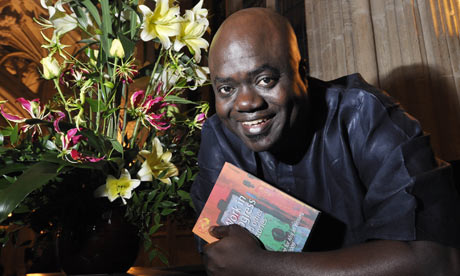 Annually an African short story writer receives the Caine Prize, which is a £10,000 award, founded in England in 2000 and is supported by Nobel Prize literature winners Wole Soyinka, Nahguib Mahfouz, Nadine Gordimer, J. M. Coetzee and a various organisations and funds. The name for the prize is a dedication to the former chairman of Booker plc, the Booker Prize management committee and Africa 95, Sir Michael Harris Caine. Ben Okri, a Nigerian writer and winner of the Booker Prize, chaired the first panel of Caine Prize judges. He is a wonderful writer, so if you do not know him yet, watch the interview with him (below) when he was in Denmark.
2009 made it its tenth anniversary of the Caine Prize, and the year in which E.C. Osondu could add another award to his collection. He has previously won the Allen and Nirelle Galso Prize for fiction, and his story "A Letter from Home" was judged one of the "Top Ten Stories on the Internet" in 2006.
"Waiting" is the title of Osondu's award-winning story, which take place among refugees. Read it on the link below.
Read the award-winning "Waiting" here or in a pdf file here
Visit the official website and check out the other winners and nominees
Must see Ben Okri interview in the Black Diamond, Copenhagen, Denmark!
Read other stories here
Saturday, November 22, 2008
Looking at the stars
 For more than 700 years the Dogon people of Mali have had an exceptional astronomical knowledge using only the naked eye. They studied the star Sirius (which is 8.6 light years away) and its invisible companion star Sirius B (it was discovered in 1862 by an American who used the largest telescope of that time) which has a 50 year elliptical orbit and further they told that Sirius B rotates on its own axis. They even have astronomical drawings of it which match the modern western ones even though the Dogon people did not have telescopes and all these fancy facilities the Europeans use.
Professor Ivan van Sertimer, author of Black Women in Antiquity and They Came before Columbus among others, wrote an article of the name The Lost Sciences of Africa in which he argues that the Dogon had a vast modern knowledge of the solar system, and indeed the Dogon knew of the surface of the moon and the characteristics of Sirius B, beyond the awareness of western astronomers.
Even though Professor Ivan van Sertimer and Hunter Adams, African Observers of the Universe - the Sirius Question, find the Dogon's observations intriguing, Robert Temple, a member of the Royal Astronomical Society of Great Britain, thinks that the Dogon possibly could have had the information passed to them by extraterrestrials! An extremely eurocentric view backed up by an astronomer by the name of Carl Sagan who thinks the Dogon got enlightenment from European explorers; exactly as other Europeans suggested that the pyramids and the Great Zimbabwe were built with help from extraterrestrials. Once again Africans will point the Europeans wrong as they have evidence on their side. Maybe the Dogon are the descendants of the ancient Egyptians, and they passed on their knowledge through generations as they've migrated to Mali. Anyhow, they have their place in African history.

Sunday, November 9, 2008
Memorable pictures; meaning of life

Sighting happiness on dusty earth
Beautiful man child by his mother’s bosom
Curiously sensing around him plenty mirth
Material possessions are not needed to make life worth
Saturday, October 18, 2008
Blessed Mo'Kalamity
Just a quick introduction to Mo'Kalamity and the band the Wizards. You wouldn't know her without listening to this amazing voice from France first. The album "Warriors of Light" came out last year and it is one of the best of 2007. Check out some of her songs on myspace and if you check out her cd then make sure you hear "Princess from the street", "Evolution", "Darling" and "Africa"!


Wednesday, October 15, 2008
Commemoration
Commemoration; I could not come up with other words which summarize all I want to speak in this first entry. My intention is to big up African people, period.
Africa, the craddle of humanity, which gave birth to everything; the Bible, literature, oral tradition, philosophy, education, art and dance, monarchies, the greatest men and women of time, black pearls in every way and in every key word which I wrote down holds a love and inspiration which cannot be copied.
Beautiful African queens of every shade of black, they are the true mothers of mothers. They continue to be a part of every aspect of Life whether it be grass root movement, politicians, business or singers. Women of any color hold the possibility of change in themselves. They are the ones who give birth and bring up children, and in them is the future. Therefore women must be respected, educated, understood and admired because they have had their confidence taken away from them, especially African women. When I say African, I do not solely mean people IN Africa but Black people, at home or abroad.
Every journey begins with the first step, and the first step should start with the men, they are the fathers, husbands and brothers who must support their daughters, wives and sisters. Men cannot keep disrespecting women in music videos and make them sex objects. Conscious women must not be fooled by the media's vain image of beauty, and neither must men. True beauty comes from within (I am aware that it's kind of a cliche now) but when you are confident in yourself and your worth, it shines out to your outer appearance.
I kinda drew a bit away from my point, but given the long and painful hardships Black people have been and are still exposed to by white people mainly, it is inevitable to be anything else but amazed (and for me, grateful; make Black history month every month!) that they are so strong. Europeans (included Americans, Australian Europeans etc.) cannot apologize enough for the atrocities commited and the ones being commited this very instance.
I hope by writing this blog about pretty much everything from African culture/literature/music and news AND my thoughts will shed a little light on African awareness as I myself have been educated by Africans.
Jah guidance and blessings as we are given life yet another day
Africa, the craddle of humanity, which gave birth to everything; the Bible, literature, oral tradition, philosophy, education, art and dance, monarchies, the greatest men and women of time, black pearls in every way and in every key word which I wrote down holds a love and inspiration which cannot be copied.
Beautiful African queens of every shade of black, they are the true mothers of mothers. They continue to be a part of every aspect of Life whether it be grass root movement, politicians, business or singers. Women of any color hold the possibility of change in themselves. They are the ones who give birth and bring up children, and in them is the future. Therefore women must be respected, educated, understood and admired because they have had their confidence taken away from them, especially African women. When I say African, I do not solely mean people IN Africa but Black people, at home or abroad.
Every journey begins with the first step, and the first step should start with the men, they are the fathers, husbands and brothers who must support their daughters, wives and sisters. Men cannot keep disrespecting women in music videos and make them sex objects. Conscious women must not be fooled by the media's vain image of beauty, and neither must men. True beauty comes from within (I am aware that it's kind of a cliche now) but when you are confident in yourself and your worth, it shines out to your outer appearance.
I kinda drew a bit away from my point, but given the long and painful hardships Black people have been and are still exposed to by white people mainly, it is inevitable to be anything else but amazed (and for me, grateful; make Black history month every month!) that they are so strong. Europeans (included Americans, Australian Europeans etc.) cannot apologize enough for the atrocities commited and the ones being commited this very instance.
I hope by writing this blog about pretty much everything from African culture/literature/music and news AND my thoughts will shed a little light on African awareness as I myself have been educated by Africans.
Jah guidance and blessings as we are given life yet another day
Subscribe to:
Posts (Atom)




.jpg)