Showing posts with label native americans. Show all posts
Wednesday, February 1, 2012
Excerpt from 'Twasinta’s Seminoles / Rape of Florida'
Albery A. Whitman was born in 1851, Hart County, Kentucky, and lived an existence in slavery
until 1863. Already an orphan by 12, he accomplished to be a well known
minister of the AME church (African Methodist Episcopal Church) and a
schoolteacher by the age of 25. He is known for his epic-length poem “Not a man
and yet a Man” published in 1877, though his best known work is The Rape of Florida, published 1884, and
reprinted the following year Twasinta’s
Seminoles. In 1890 both poems were again reprinted along with some short
poems. In 1893 he composed and read “The Freedman’s Triumphant Song” at the
Chicago World’s Fair. The Octoroon, An
Idyl of the South, his last publication, came out in 1901, the year he
passed away. He fought a hard struggle with alcohol and pneumonia but he was a
light in this world with his wonderful words.
The following excerpt is from Twasinta’s
Seminoles / Rape of Florida.
Canto 1
I
The negro slave by Swanee River sang;
Well-pleased he listened to his echoes ringing;
For in his heart a secret comfort sprang,
When Nature seemed to join his mournful singing.
To mem’ry’s cherished objects fondly clinging;
His bosom felt the sunset’s patient glow,
And spirit whispers into weird life springing,
Allured to worlds he trusted yet to know,
And lightened for awhile life’s burdens here below.
II
The drowsy dawn from many a low-built shed,
Beheld his kindred driven to their task;
Late evening saw them turn with weary tread
And painful faces back; and dost thou ask
How sang these bondmen? how their suff’rings mask?
Song is the soul of sympathy divine,
And hath an inner ray where hope may bask;
Song turns the poorest waters into wine,
Illumines exile hearts and makes their faces shine.
III
The negro slave by Swanee river sang,
There soon the human hunter rode along;
And eagerly behind him came a gang
Of hounds and men, – the bondmen hushed his song –
Around him came a silent, list’ning throng;
“Some runaway!” he muttered; said no more,
But sank from view the growing corn among;
And though deep pangs his wounded spirit bore,
He hushed his soul, and went on singing as before.
IV
So fared the land where slaves were groaning yet –
Where beauty’s eyes must feed the lusts of men!
‘Tis as when horrid dreams we half forget,
Would then relate, and still relate again –
Ah! cold abhorrence hesitates my pen!
The heavens were sad, and hearts of men were faint;
Philanthropy implored and wept, but then
The wrong, unblushing trampled on Restraint,
While feeble Law sat by and uttered no complaint.
V
“Fly and be free!” a whisper comes from heaven,
“Thy cries are heard!” the bondman’s up and gone!
To grasp the dearest boon to mortals given,
He frantic flies, unaided and alone.
To him the red man’s dwellings are unknown;
But he can crave the freedom of his race,
Can find his harvests in the desert sown,
And in the cypress forest’s dark embrace
A pathway to his lonely habitations trace.
VI
The sable slave, from Georgia’s utmost bounds,
Escapes for life into the Great Wahoo.
Here he has left afar the savage hounds
And human hunters that did late pursue;
There in the hommock darkly hid from view,
His wretched limbs are stretched awhile to rest,
Till some kind Seminole shall guide him thro’
To where by hound nor hunter more distrest,
He in a flow’ry home, shall be the red man’s guest.
VII
If tilled profusion does not crown the view,
Nor wide-ranged farms begirt with fences spread;
The cultivated plot is well to do;
And where no slave his groaning life has led,
The songs of plenty fill the lowliest shed.
Who could wish more, when Nature, always green,
Brings forth fruit-bearing woods and fields of bread?
Wish more, where cheerful valleys bloom between,
And herds browse on the hills, where winter ne’er has been?
[…]
X
Fair Florida! whose scenes could so enhance –
Could in the sweetness of the earth excel!
Wast thou the Seminole’s inheritance?
Yea, it was thee he loved, and loved so well!
‘Twas ‘neath thy palms and pines he strove to dwell.
Not savage, but resentful to the knife,
For these he sternly struggled – sternly fell!
Thoughtful and brave, in a long uneven strife,
He held the verge of manhood mid the heights of life.
XI
A wild-born pride endeared him to thy soil!
When roamed his herds without a keeper’s care –
Where man knew not the pangs of slavish toil!
And where thou didst not blooming pleasures spare,
But well allotted each an ample share,
He loved to dwell: Oh! isn’t the goal of life
Where man has plenty and to man is fair?
When free from avarice’s pinch and strife,
Is earth not like the Eden-home of man and wife?
[…]
XIX
Oh! sing it in the light of freedom’s morn,
Tho’ tyrant wars have made the earth a grave;
The good, the great, and true, are, if so, born,
And so with slaves, chains do not
make the slave!
If high-souled birth be what the mother gave, –
If manly birth, and manly to the core, –
Whate’er the test, the man will he behave!
Crush him to earth and crush him o’er and o’er,
A man he’ll rise at last and meet you as before.
XX
So with our young Atlassa*, hero-born, –
Free as the air within his palmy shade,
The nobler traits that do the man adorn,
In him were native: Not the music made
In Tampa’s forests or the everglade
Was fitter than in this young Seminole
Was the proud spirit which did life pervade,
And glow and tremble in his ardent soul –
Which, lit his inmost-self, and spurned all mean control.
XXI
Than him none followed chase with nimbler feet,
None readier in the forest council rose;
To speak for war, e’er sober and discreet,
In battle stern, but kind to fallen foes;
He led the charge, but halted,
– slow to close
The vexed retreat: In front of battle he,
Handsome and wild his proud form would expose;
But in the cheering van of victory,
Gentle and brave he was the real chief to see.
XXII
Lo! mid a thousand warriors where he stands,
Pride of all hearts and idol of his race!
Look how the chieftains of his war-tried bands
Kindle their courage in his valiant face!
And as his lips in council open, trace
How deep suspense her earnest furrows makes
On ev’ry brow! How rings the forest-place
With sounding cheers! when native valor wakes
His dark intrepid eyes, and he their standard takes!
XXIII
Proud spirit of the hommock-bounded home
Well wast thy valor like a buckler worn!
And when the light of the other times shall come, –
When history’s muse shall venture to adorn
The brow of all her children hero-born, –
When the bold truth to man alike assigns
The place he merits, of no honor shorn;
The wreath shall be, that thy proud brow entwines,
As green as Mickasukie’s** everlasting pines!
XXIV
Well bled thy warriors at their leader’s side!
Well stood they the oppressor’s wasting fire;
For years sweep on, and in their noiseless tide,
Bear down the mem’ries of the past! The dire
And gloomful works of tyrants shall exire,
Till naught survives, save truth’s great victories;
Then shall the voyager on his way aspire
To ponder what vast wrecks of time he sees,
And on Fame’s temple columns read their memories!
XXV
Not so with Osceola***, thy dark mate;
The hidden terror of the hommock, he
Sat gloomily and nursed a bitter hate, –
The white man was his common enemy –
He rubbed the burning wounds of injury,
And plotted in his dreadful silent gloom;
As dangerous as a rock within the sea.
And when in fray he showed his fearless plume,
Revenge made sweet the blows that dealt the white man’s doom.
XXVI
The pent-up wrath that rankled in his breast,
O’er smould’ring embers shot a lurid glare,
And wrongs that time itself had not redrest,
In ghost-like silence stalked and glimmered there.
And from the wizard caverns of despair,
Came voice and groan, reminding o’er and o’er
The outrage on his wife so young and fair;
And so, by heaven and earth and hell he swore
To treat in council with the white man never more.
XXVII
Such were the chiefs who led their daring braves
In many a battle nobly lost or won,
And consecrated Mickasukie’s graves
To that sweet province of the summer sun!
And still shall history forgetful run?
Shall legend too be mute? then Poesy,
Divinest chronicler of deeds well done,
From the blest shrine and annals of the free,
Sing forth thy praise and man shall hear attentively.
XXVIII
The poorest negro coming to their shore,
To them was brother – their own flesh and blood, –
They sought his wretched manhood to restore, –
They found his hidings in the swampy wood,
And brought him forth – in arms before him stood, –
The citizens of God and Sovran earth, –
They shot straight forward looks with flame imbued,
Till in him manhood sprang, a noble birth,
And warrior-armed he rose to all that manhood’s worth.
XXIX
On the dark front of battle often seen,
Or holding dang’rous posts through dreadful hours, –
In ranks obedient, in command serene,
His comrades learn to note the tested powers
Which prove that valor is not always ours,
Be whomsoever we: A common race
Soon from this union flows – soon rarest flowers
Bloom out and smile in beauty’s blending grace,
And rivals they become for love’s sublimest place.
XXX
The native warrior leads his ebon maid,
The dark young brave his bloom-hued lover wins;
And where soft spruce and willows mingle shade,
Young life mid sunniest hours its course begins:
All Nature pours its never-ending dins
In groves of rare-hued leaf without’n end, –
‘Tis as if Time, forgetting Eden’s sins,
Relents, and spirit visitors descend
In love’s remembered tokens, earth once more to blend.
XXXI
The sleepy mosses wave within the sun,
And on the dark elms climbs the mistletoe;
Great tangled vines through pendant branches run,
And hang their purple clusters far below;
The old pines wave their summits to and fro,
And dancing to the earth, impatient light
Touches the languid scene, to quickly go,
Like some gay spirit in its sunny plight,
That, visiting the earth, did glance and take its flight…
* “Atlassa” refers to Wild Cat, also called Coacoochee, who was a
leading Seminole chief during the 2nd Seminole War
** Miccosukee
– name of a Native American tribe and an area in Florida
*** Osceola was an influential leader and war
leader among the Seminoles
Sunday, July 12, 2009
Conservation of Life
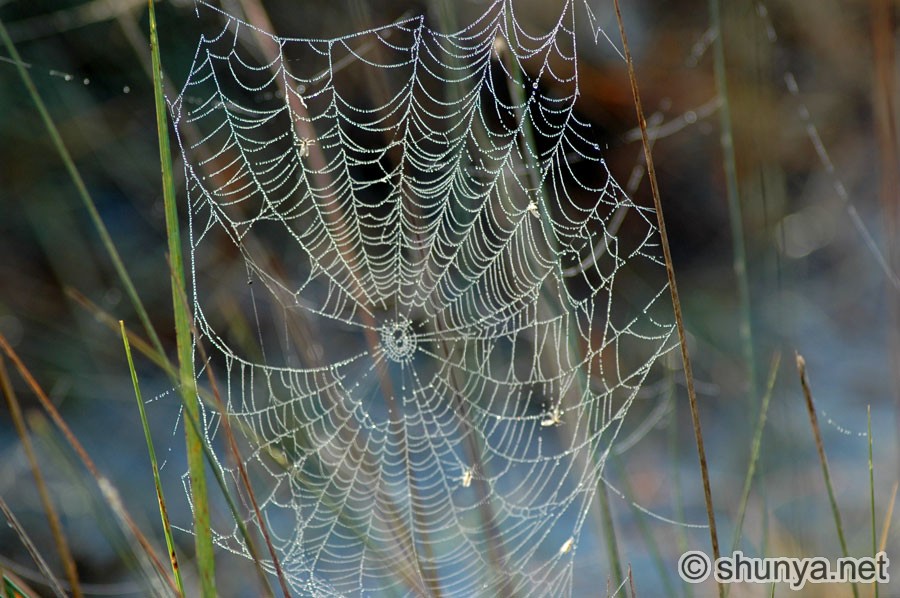
iktomi: [ick-toh'-me] literally means spider in the Lakota language. In Lakota legends Iktomi is a spider-trickster, and the stories about him are meant to teach.
I have it! I finally have it! I've been in and out of the same antiquarian bookshop a hundred times looking at the same book for months, just to make sure that it had not been sold. Everytime I told myself 'it will not get sold, who buys these kinds of books anyway. Besides me..' (to my misfortune, I could never afford the book). But experience taught me that it is not the right attitude when you really want something (that experience had me on the verge of tears, I remember). So I did what every person in their right mind would do; I haggled the price. In that moment I hoped that the man I was negotiating the price with, had not been in the shop half the times I had left the place empty-handed. 5 minutes later I left the shop with a smile that would have seemed to scare every stoic Dane passing my way.
As soon as I had found the most desolate corner in the metro I pulled out my copy of America Needs Indians! by Iktomi Hicala from 1937 and turned the dry pages of the book.
The man was truly wise but I could barely find anything on him. My first problem was whether his name is Iktomi Hicala or Iktomi Lila Sica. He introduces the book with a letter to the Commissioner of Indian Affairs, John Collier, signed Iktomi Lila Sica, and when you turn the page and read above the title of the book, it states: "Blame only Iktomi Hicala and thank The Indians and their friends who were of aid to This World's Worst Book."
The only useful information on the internet is a fascinating passage from a book called Conservation Refugees: the Hundred-Year Old Conflict between Global Conservation and Native Peoples by Mark Dowie where it says that Lakota Chief Iktomi Lila Sica made a proposal in 1930 to have their own Community Conservation Area in South Dakota which would hold an Indian University that would teach Lakota ecological knowledge and culture. The proposal was rejected but the idea was carried through in the 70s by the Blackfeet, Ogala Sioux and Havasupi reservations which established parks within or close to their land. 40 years. I wonder how the land and the conditions for the Lakota people and others had been today if they were given the acceptance to fulfill their ideas.
Ikotomi writes in the spirit of Iktomi, the spider-trickster. He writes on subjects so serious and crucial, for example the rightful 'owners' of America, politics, economy, race, civilization and culture; subjects which may evoke anger, but are handled with such a wit and straight, profound seriousness that leaves you wondering, thinking and soaking up all his words and drawings.
His purpose with the book, as he wrote in the letter addressed to John Collier, is to prove he doesn't know a thing and at that point he has already won a hundred battles.

Iktomi's book is a collection of thoughts and 'non-art', however, the product of one man's creativity woven together into a whole, like a spider web, of significant threads.
A people cannot live on its history alone, and Iktomi has the insight of history and economy to provoke and question the shaky foundations of America.
On top of that, he made that effort to try to gain an area for conservation and education, a solid foundation for a people with so much to teach and so much to defend and protect.

As soon as I had found the most desolate corner in the metro I pulled out my copy of America Needs Indians! by Iktomi Hicala from 1937 and turned the dry pages of the book.
The man was truly wise but I could barely find anything on him. My first problem was whether his name is Iktomi Hicala or Iktomi Lila Sica. He introduces the book with a letter to the Commissioner of Indian Affairs, John Collier, signed Iktomi Lila Sica, and when you turn the page and read above the title of the book, it states: "Blame only Iktomi Hicala and thank The Indians and their friends who were of aid to This World's Worst Book."The only useful information on the internet is a fascinating passage from a book called Conservation Refugees: the Hundred-Year Old Conflict between Global Conservation and Native Peoples by Mark Dowie where it says that Lakota Chief Iktomi Lila Sica made a proposal in 1930 to have their own Community Conservation Area in South Dakota which would hold an Indian University that would teach Lakota ecological knowledge and culture. The proposal was rejected but the idea was carried through in the 70s by the Blackfeet, Ogala Sioux and Havasupi reservations which established parks within or close to their land. 40 years. I wonder how the land and the conditions for the Lakota people and others had been today if they were given the acceptance to fulfill their ideas.
His purpose with the book, as he wrote in the letter addressed to John Collier, is to prove he doesn't know a thing and at that point he has already won a hundred battles.A people cannot live on its history alone, and Iktomi has the insight of history and economy to provoke and question the shaky foundations of America.
On top of that, he made that effort to try to gain an area for conservation and education, a solid foundation for a people with so much to teach and so much to defend and protect.
"I was standing on the highest mountain of them all, and round about beneath me was the whole hoop of the world. And while I stood there I saw more than I can tell and I understood more than I saw; for I was seeing in a sacred manner the shapes of all things in the spirit, and the shape of all shapes as they must live together like one being. And I saw that the sacred hoop of my people was one of many hoops that made one circle, wide as daylight and as starlight, and in the center grew one mighty flowering tree to shelter all children of one mother and one father. And I saw that it was holy...but anywhere is the center of the world."
Black Elk - Oglala Sioux
Saturday, November 8, 2008
My freedom of speech
Bless up. There is something that has been running over and over in my mind lately, and that is the lack of attention on homeless people and Native Americans during the election.
The politicians are inclined to be so mechanical. Machines who have made up an opinion about almost everything, and memerize it, before they address the people. Along the way they forget the tiniest or most fragile minority/minorities. Persons who do not have a place to call a home, whose place is different everyday, who are most likely not to break the vicious circle to create a steady life, and a people who had a culture and a way of life, which do not correspond to the modern life of the western society, are being placed in reservations in dire conditions. In some places Native Americans have a life expectancy which is lower than any country of the world, a suicide rate among teens which is 150% higher than the national average, close to total population living below the poverty line, and this ferocious reality continues to persist.
I am sure most people are mortified that this hell thrives in a powerful nation as the United States. But nothing is to be heard or seen among the ones in power.
People tend to ask questions to the politicians about matters which involve themselves, naturally (we are just humans), while others get left behind.
Democratic countries pride themselves of having the glorious rights upheld in their constitutions since many centuries, and others, decades, ago; of freedom of speech for example. Yet this magnificent right is not used to the extent one may want. The dream behind this right of saying whatever one wants is living out too slowly, and used for topics not so significant. Freedom of speech should be used to pressure the government and the change-makers among other matters, instead of ending up with voices sinking in the mire of arrogance and conservatism.
As humans we must ask ourselves if it is not time for making a change starting with the man in the mirror; change, whether it be locally or globally, speaking up on paper or with your voice, giving the homeless you pass on your way home the 30 bucks you would have used on a pair of new shoes or dedicating your life to helping others. Either way is just as important. The way has been steep and it will keep on being that but we will learn to strengthen ourselves.
Have a blessed morning, afternoon or evening to all.
Great websites
Republic of Lakotah
Homeless
Native Americans
The politicians are inclined to be so mechanical. Machines who have made up an opinion about almost everything, and memerize it, before they address the people. Along the way they forget the tiniest or most fragile minority/minorities. Persons who do not have a place to call a home, whose place is different everyday, who are most likely not to break the vicious circle to create a steady life, and a people who had a culture and a way of life, which do not correspond to the modern life of the western society, are being placed in reservations in dire conditions. In some places Native Americans have a life expectancy which is lower than any country of the world, a suicide rate among teens which is 150% higher than the national average, close to total population living below the poverty line, and this ferocious reality continues to persist.
I am sure most people are mortified that this hell thrives in a powerful nation as the United States. But nothing is to be heard or seen among the ones in power.
People tend to ask questions to the politicians about matters which involve themselves, naturally (we are just humans), while others get left behind.
Democratic countries pride themselves of having the glorious rights upheld in their constitutions since many centuries, and others, decades, ago; of freedom of speech for example. Yet this magnificent right is not used to the extent one may want. The dream behind this right of saying whatever one wants is living out too slowly, and used for topics not so significant. Freedom of speech should be used to pressure the government and the change-makers among other matters, instead of ending up with voices sinking in the mire of arrogance and conservatism.
As humans we must ask ourselves if it is not time for making a change starting with the man in the mirror; change, whether it be locally or globally, speaking up on paper or with your voice, giving the homeless you pass on your way home the 30 bucks you would have used on a pair of new shoes or dedicating your life to helping others. Either way is just as important. The way has been steep and it will keep on being that but we will learn to strengthen ourselves.
Have a blessed morning, afternoon or evening to all.
Great websites
Republic of Lakotah
Homeless
Native Americans
Labels:
america,
homeless people,
human rights,
native americans
Subscribe to:
Posts (Atom)